From Adana to Iskender: How to Read a Turkish Grill Menu Like a Regular
Photo: E4024, CC BY-SA 4.0, via Wikimedia Commons
There's a particular moment that happens in a Turkish grill house. The mezze arrive, someone at the table says 'shall we just get a bit of everything', and then a waiter appears with a mixed grill for six and everyone quietly accepts their fate. It's a lovely fate. But it's also not the only way to eat here, and it's not the way the menu was designed to be used.
So consider this your decoder. No jargon, no snobbery, just the words you need and the quantities that actually work.
The menu is really two menus
Almost every Turkish grill in the UK is split down the middle. One side is mezze — small plates, cold and hot, designed to sit on the table while everyone picks. The other side is the ocakbaşı section: skewers and cuts cooked over charcoal, served with rice or bulgur, grilled peppers and tomato, and usually a flatbread that keeps reappearing whether you asked or not.
The mistake most first-timers make is treating the grill section as a main course and the mezze as a starter. It's not a three-course menu, it's a table. Everything lands when it's ready and everyone helps themselves. If you order one main each and nothing else, you'll eat well but you'll miss the point.
Doner is not the enemy — it's just the beginning
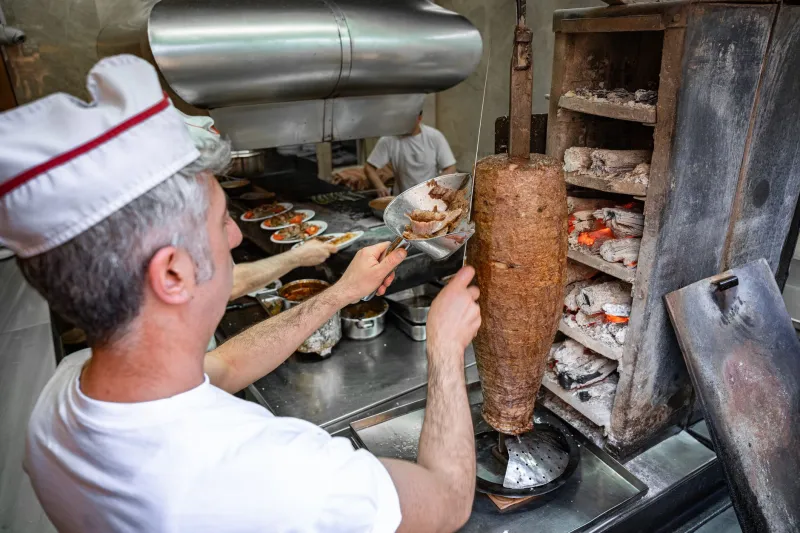
Döner simply means 'rotating'. It's meat stacked on a vertical spit and shaved off as it turns, and yes, you have almost certainly eaten it at 11pm out of a paper wrapper. At a proper grill restaurant it arrives on a plate, usually with rice, salad and bread, and it tastes like a completely different food: crisp at the edges, soft in the middle, seasoned properly.
If you want to eat it the way the kitchen intends, order it as a plate rather than a sandwich. And if you see 'döner' somewhere in the middle of a list of skewers, don't skip past it assuming you know what's coming.
Adana, Urfa, beyti: the minced lamb family
These three trip people up constantly, and they're all made from hand-minced lamb pressed onto a flat skewer.
- Adana is the famous one: minced lamb with red pepper and a decent kick of heat, charred hard over the coals. Named after the city in southern Turkey and genuinely worth ordering at least once.
- Urfa is the same idea with the chilli dialled right down. Milder, slightly sweeter, ideal if someone at your table doesn't do heat or if you want the lamb to do the talking.
- Beyti is Adana in a smarter outfit: wrapped in flatbread, sliced, covered in tomato sauce and yoghurt with butter poured over at the table. Rich, messy, brilliant for sharing.
Shish, wings and ribs: the cubed-meat side
'Shish' just means skewered. Chicken shish and lamb shish are cubed meat, marinated, grilled quickly so the middle stays juicy. Lamb shish is the one to order if you like your meat slightly pink — ask for it that way, because the kitchen will happily cook it through by default.
Beyond that you're into the good stuff. Lamb ribs (kaburga) are fatty in the best possible way and need fingers. Chicken wings are usually excellent and cheap. Köfte are little grilled patties, often the kids' favourite. And if you're feeling brave, liver (ciğer) is a proper ocakbaşı classic — order it once, decide for yourself.
Iskender: the one with the theatrical finish
An Iskender is doner meat laid over cubes of pide bread, dressed with tomato sauce and yoghurt, and finished with sizzling butter poured over at the table. It's the richest thing on most menus by a distance.
Two things worth knowing. First, it's a full meal in itself — don't pair it with three other mains. Second, you can ask for it without the butter, or with the yoghurt on the side, and nobody will be offended. Plenty of regulars do.
How much to order for four people
Here's a working rule we'd happily defend: two or three cold mezze, two hot mezze, one large mixed grill to share between two, one or two skewers on top if the table is hungry, one pide from the oven, one big salad. Bread comes as standard; ask for extra lavash anyway.
That feeds four comfortably, gives you a bit of everything and leaves room for künefe. If you have teenagers in the house, add another mixed grill and stop thinking about it.
The questions that make you sound like a regular
None of these are tricks — they're just the things people who eat here often actually say.
- 'What's good on the charcoal today?' Kitchens appreciate being asked.
- 'Can the lamb shish come a bit pink?'
- 'Chilli sauce on the side, please.'
- 'Extra bread for the table.'
- 'Is the mixed grill big enough for three, or should we add a kebab?'
- 'Çay all round at the end.' That's Turkish tea, in the little tulip glasses, and it's the correct way to finish.
Drinks, puddings and the walk home
Ayran — the salty yoghurt drink — cuts through grilled meat far better than a lager does, and it's what most of the room is drinking. Şalgam is the other one: a sour turnip juice, pink, deeply savoury, and either your new favourite thing or a one-time experiment.
For pudding, künefe is the star: shredded pastry around melted cheese, baked and soaked in syrup, served hot. It's sweet enough to share four ways. Baklava and rice pudding are the safer bets if you're pacing yourself.
Order like this once and the menu stops looking like a wall of unfamiliar words. It becomes what it always was: a list of things designed to be put in the middle of the table and argued over. Which is, frankly, the best kind of menu there is.